How a Front Door Migration Pushed Me into SEO
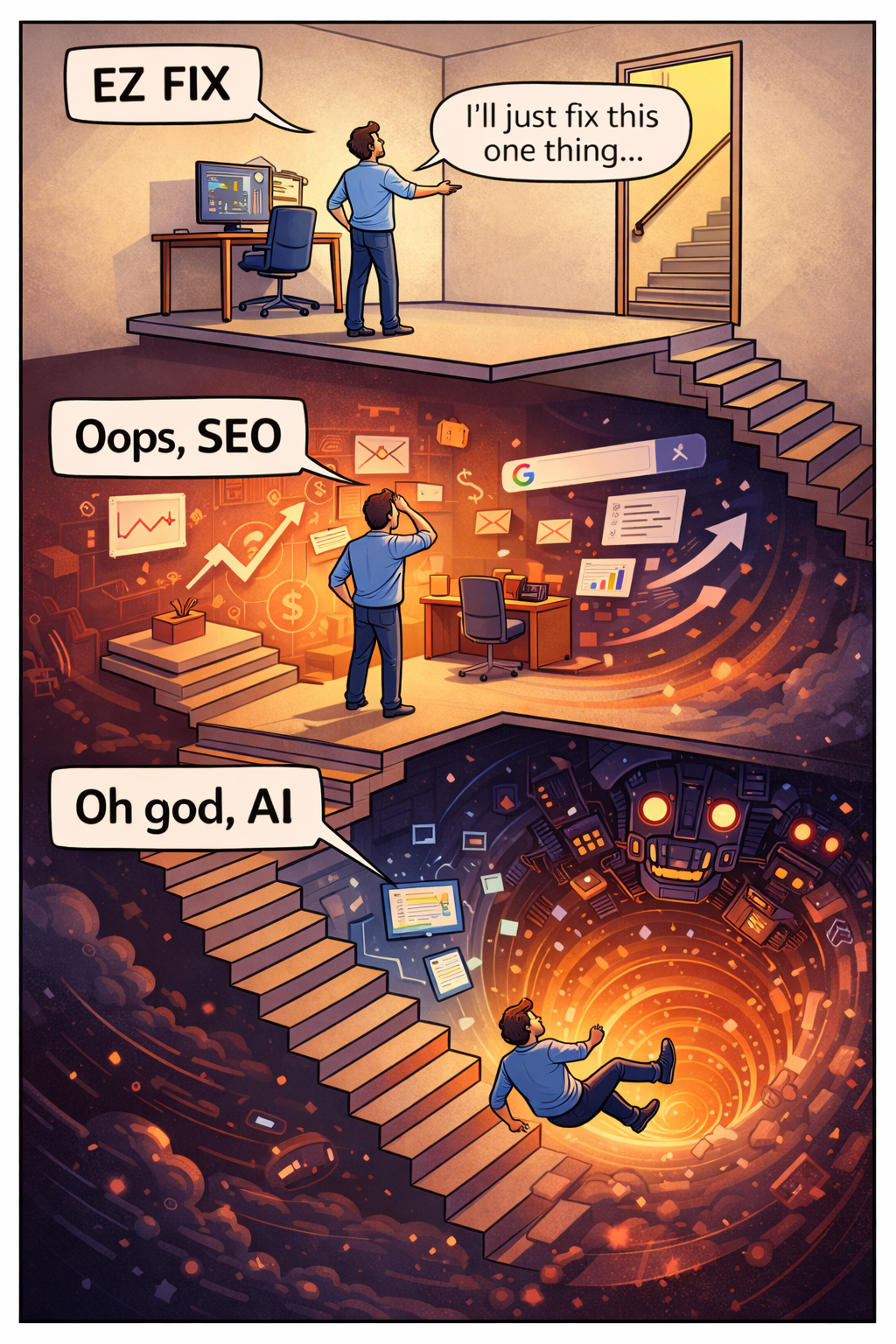
I just wanted to make the Azure setup free again
This was never meant to turn into an SEO story.
The original goal was simple and, frankly, a bit boring: I wanted to make my Azure setup cost-free again.
Azure Front Door had done its job well, but for a small personal blog it had slowly become unnecessary overhead.
Static Web Apps offered everything I actually needed — HTTPS, global distribution, predictable performance — without recurring costs.
So I migrated the setup. Front Door out, Static Web Apps in. The infrastructure was simpler, cheaper, and finally back to zero running cost.
At that point, I even wrote the documentation for the migration, convinced this would remain a purely technical story.
Then I noticed the JSON-LD
While wrapping things up, I did what I usually do before considering something “done”: I looked at the rendered HTML. Not because I expected problems, but because habit tends to catch things checklists don’t.
That’s when I noticed the JSON-LD.
It was there. It looked reasonable. And yet, when I checked Google’s tooling, the results were oddly inconsistent. Some parts were detected, others weren’t. Rich results behaved unpredictably. Nothing was clearly broken, but nothing inspired confidence either.
This was supposed to be a quick fix.
Just a small cleanup before moving on.
How a small fix turned into an SEO rabbit hole
Once you start questioning structured data, it’s surprisingly hard to stop. If JSON-LD can be present and still unreliable, what does Google actually trust? Why do impressions show up without clicks? Why does a carefully written meta description sometimes get ignored entirely?
Somewhere along that line of thinking, I realized I had crossed a boundary.
I wasn’t debugging markup anymore — I was reasoning about search behavior. Without meaning to, I had stepped into the SEO rabbit hole.
And that’s when it became obvious how little I actually understood.
I’m not a Search Engine Optimizer. I’m an Architect.
My professional comfort zone is systems with clear inputs and outputs. If something breaks, it usually does so deterministically. Configurations are either valid or invalid, and behavior can be traced, reproduced, and explained.
SEO doesn’t work like that.
It reacts to users. It changes slowly. It rewrites your intentions. And it does not care whether your setup is technically correct if it doesn’t align with what people expect to see.
That mismatch between how I’m used to thinking and how SEO actually behaves was uncomfortable — and impossible to ignore.
It’s 2026, so I asked an AI
In earlier years, this would have meant digging through outdated blog posts, contradicting advice, and a lot of guesswork.
But it’s 2026, and the obvious thing to do was to ask an AI — not for tricks or shortcuts, but for explanations.
I wanted to understand what still matters, what no longer does, and how a small, developer-written blog fits into the current search landscape.
That inquiry pulled me into a second rabbit hole. The problem stopped being “How do I fix JSON-LD?” and turned into something broader: what SEO actually means today when you’re not trying to sell anything.
What changed (and what didn’t)
The outcome wasn’t dramatic. There was no big rewrite, no keyword strategy, no optimization spree.
What changed was mostly intent and clarity. Titles became more explicit. Descriptions started describing expectations instead of summarizing content. Headings aligned more closely with what a reader — or a search engine — might reasonably look for.
What didn’t change was the pace. I stopped after making those adjustments. SEO is slow by nature, and changing too much too quickly only erases the baseline you need to understand what’s happening.
Where this leaves things
Right now, the data is still thin. There are impressions, but very few clicks.
Some queries make sense immediately, others less so. That’s fine. This article isn’t meant to conclude anything.
It’s meant to mark the moment where a purely technical task quietly turned into something else.
What comes next
This is intentionally the first part.
In three to four weeks, I’ll revisit this with actual Google Search Console data. Not anecdotes, not impressions, but numbers. What moved, what didn’t, and which assumptions didn’t survive contact with reality.
No success story.
No SEO victory lap.
Just evidence.
Why this article exists at all
This is a meta article by design.
I wanted to save a bit of money on Azure. I fixed some JSON-LD along the way. And without planning to, I ended up rethinking how search, content, and intent interact — with help from AI.
That escalation felt worth documenting.