Early SEO Signals Didn’t Hold - What Actually Persisted Over Time
Intro
Early SEO signals didn’t hold.
Shortly after publishing the original article, impressions increased sharply for a few days. A few pages appeared in search results, and for a moment it looked like something had changed.
Looking back after a few months, that impression was misleading.
The initial spike faded, and what followed was a much slower, less obvious process. Visibility didn’t disappear, but it also didn’t develop in a clear or predictable way.
What didn’t hold
The most obvious example is the early spike in impressions.
Shortly after publishing, visibility increased sharply for a few days, then dropped again. At the time, this looked like a potential turning point. In hindsight, it appears to have been closer to a short-lived test than a sustained change.
Clicks followed a similar pattern. There were a few isolated events, but no consistent trend. Even as impressions increased over time, clicks remained low and irregular.
More importantly, neither pages nor queries stabilized in a meaningful way.
No single article emerged as a clear entry point. The original post gained visibility over time, but so did a range of unrelated older articles. Instead of one piece of content “winning”, visibility spread across multiple pages.
The same applies to search queries. Rather than consolidating around a small set of topics, queries remained fragmented and loosely connected. Some were directly related to the original article, others pointed to entirely different content on the site.
In other words: the early signals suggested direction, but not stability.
What actually persisted
While most early signals didn’t hold, the overall visibility didn’t disappear. It changed.
Instead of short-lived spikes, impressions became more consistent over time. The absolute numbers are still small, but they are less volatile. Rather than appearing briefly and dropping off again, pages now show up in search results more regularly.
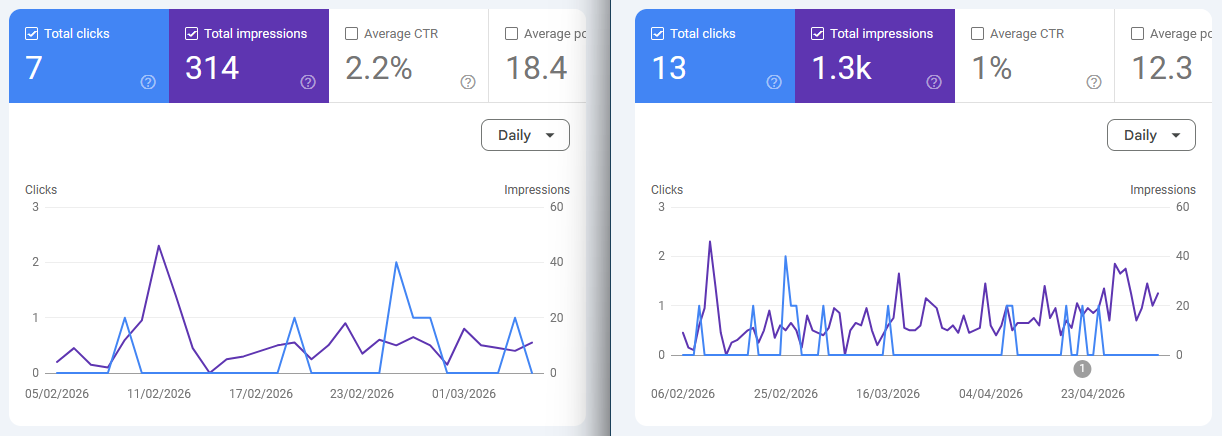
Timeframes of this and the following comparisons are the first 4 weeks after change implementation versus the last 8 weeks.
This shift is subtle, but important. It suggests that the site is no longer being treated as something to test occasionally, but as something worth observing continuously.
At the same time, average position improved noticeably. Across the dataset, rankings moved from roughly the third or fourth page closer to the boundary of the first and second page.
This didn’t translate into meaningful traffic, but it indicates that the content is being evaluated differently over time.
What persisted, therefore, is not a specific page or query, but a broader presence.
Visibility became more evenly distributed across the site. Multiple articles — some new, some several years old — started appearing in search results without a clear hierarchy.
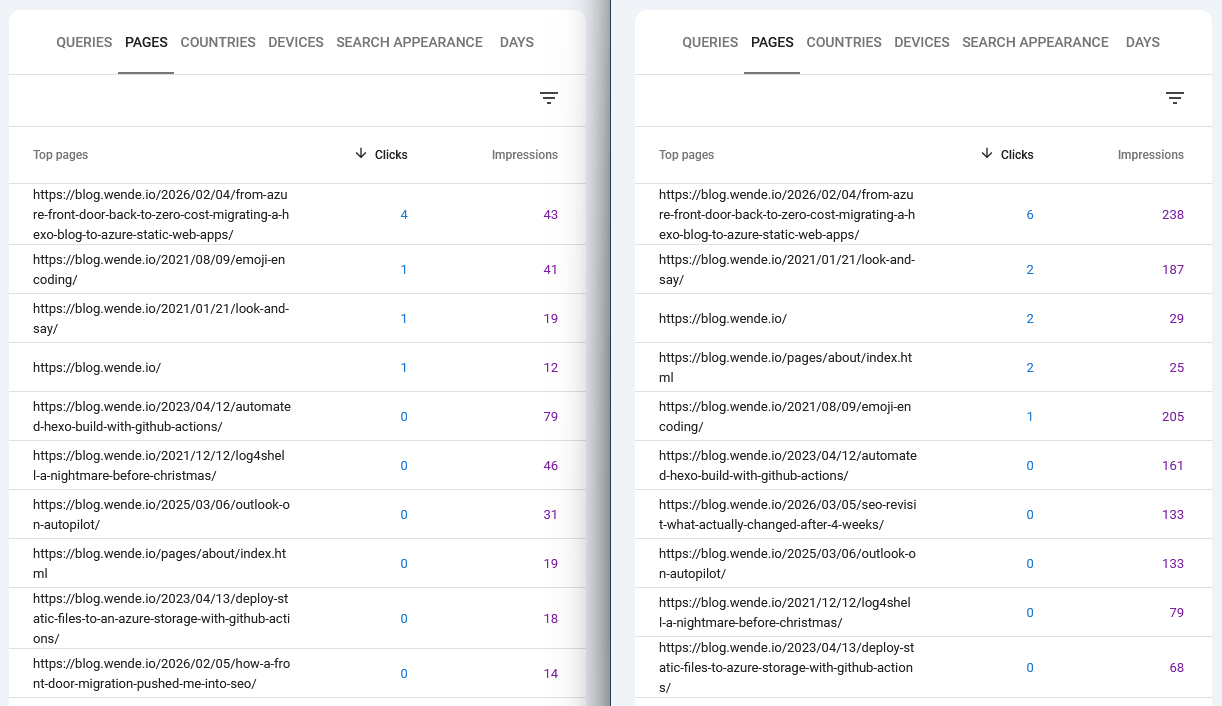
Instead of one entry point emerging, several pages accumulated impressions in parallel. Some of them were only loosely related to the original topic.
The same pattern can be seen in queries.
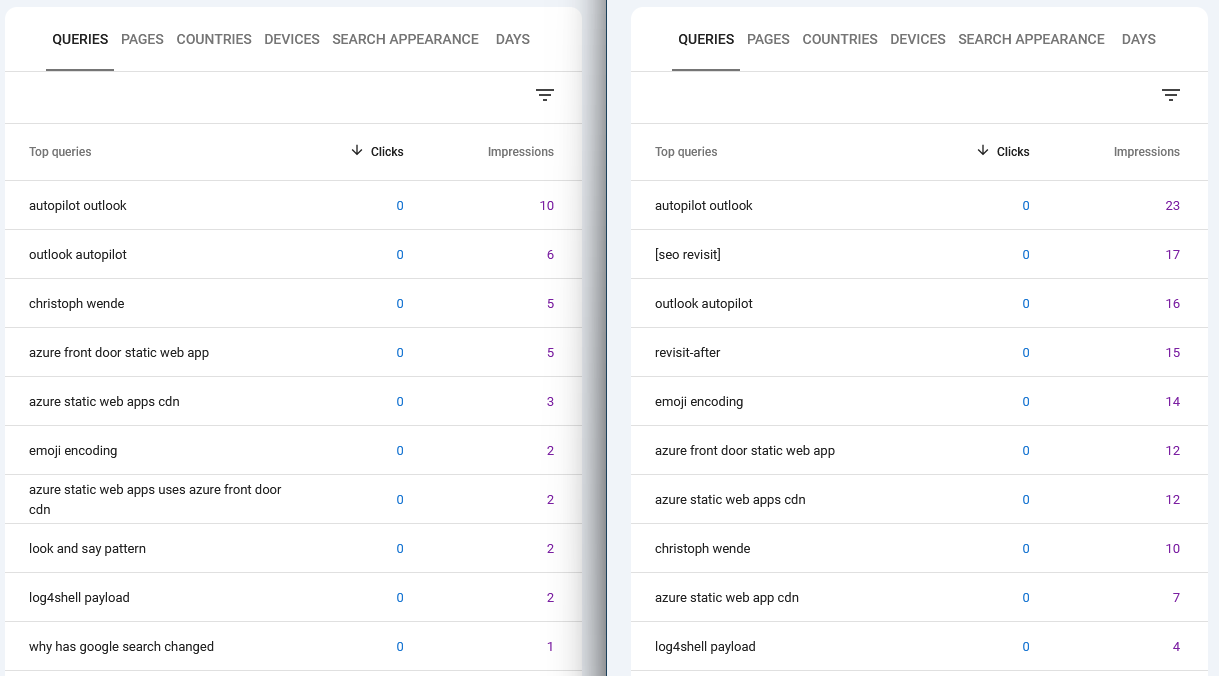
Search queries did not converge into a clear theme. They remained fragmented, ranging from infrastructure-related topics to unrelated older posts.
This makes the overall picture harder to interpret, but also more realistic.
What persisted was not focus, but distribution.
No clear convergence
Taken together, the changes are real, but not decisive.
Impressions increased. Rankings improved. More pages became visible. But none of these changes resulted in a clear outcome such as sustained traffic, a dominant article, or a well-defined topic cluster.
Growth, in this case, did not follow a linear or event-driven pattern. There was no single moment where visibility clicked.
Instead, the changes resemble a slow rebalancing.
Content that was previously invisible started to appear occasionally. Some of it persisted, some of it didn’t. Over time, this resulted in a broader, but still unstable presence in search.
One side effect of this broader visibility is a lower click-through rate. As pages appear for a wider range of loosely related queries, impressions increase faster than relevance.
In other words: more visibility does not necessarily mean more usefulness.
This is, of course, a very small dataset.
The site itself is small, the traffic is minimal, and its statistical significance is, at best, limited.
Still, the way these signals behave over time is hard to ignore.
What I was wrong about
Looking back, one assumption in particular didn’t hold.
I expected that if something worked, it would become obvious.
That one article would start to rank consistently. That queries would stabilize. That impressions would translate into clicks in a somewhat predictable way.
None of that happened.
Instead, the system behaved more like a continuous evaluation process. Signals appeared, disappeared, and reappeared in slightly different forms. Progress was not marked by clear milestones, but by small, distributed changes.
This doesn’t mean that nothing is happening. It just means that the effects are less direct than expected.
Current state
At this point, the site has a small but persistent presence in search.
- Impressions are higher than in the initial phase
- Rankings have improved
- Multiple pages are visible
- Clicks remain rare
There is no clear indication yet that this will evolve into meaningful traffic.
But there is also no sign that the visibility is purely temporary.
Closing
This started as a side effect of an infrastructure change, described in the original article. A first follow-up after four weeks is available in a separate article.
It turned into a small experiment, and over time into a slightly better understanding of how unpredictable search visibility can be, especially at this scale.
If there is a takeaway, it’s probably this:
Early signals are easy to overinterpret. What persists is usually less visible, slower, and harder to attribute.
The experiment isn’t really finished, but at this point the behavior is clear enough to stop looking for a simple explanation.